
ZWO ASI2600MM Pro
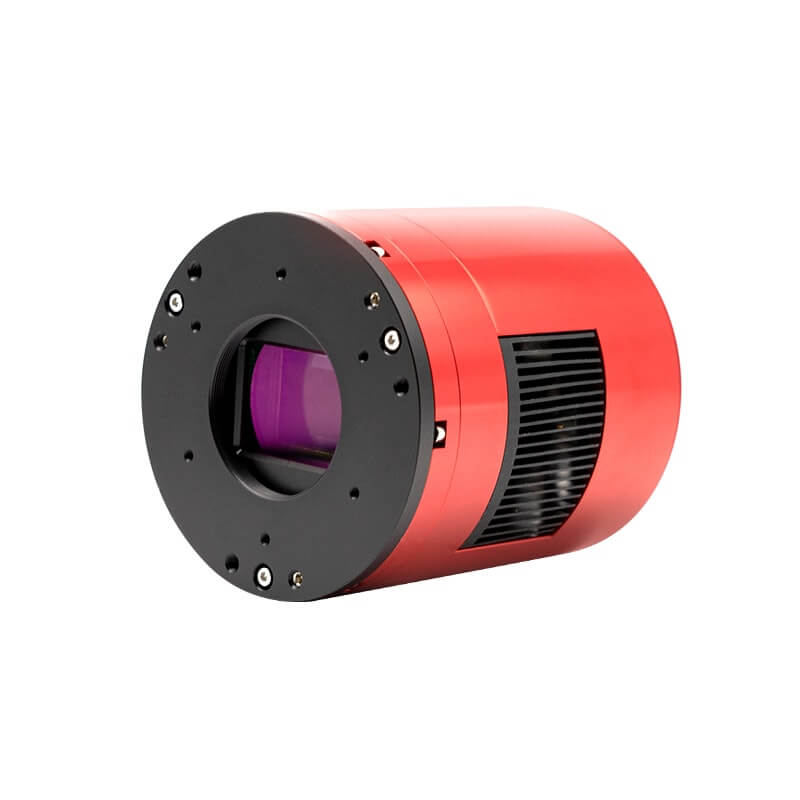
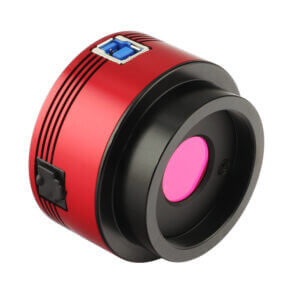
The ZWO ASI2600MM Pro is engineered for astrophotographers who demand the best in image quality and performance. Central to this camera’s exceptional capabilities is the Sony IMX571 APS-C sensor, which offers a remarkable 26 MP resolution, capturing intricate details in deep-sky objects and planetary features. This sensor is not only high resolution but also back-illuminated (backlit), a technology that significantly enhances its sensitivity to light.

The back-illuminated sensor design is a crucial advancement for astrophotography. Unlike traditional sensors, where the wiring is on the front side, potentially blocking some light, a back-illuminated sensor has its wiring on the rear. This design allows more light to reach the photodiodes, increasing the sensor’s quantum efficiency (QE) and overall sensitivity. For astrophotographers, this means better performance in low-light conditions, such as capturing faint deep-sky objects. The ASI2600MM Pro’s sensor achieves an impressive peak QE, ensuring that even the faintest stars and nebulae are captured with clarity.
Another standout feature of the ASI2600MM Pro is its native 16-bit analog-to-digital converter (ADC). With 16 bits, the ADC can produce 65,536 distinct levels of grayscale, compared to only 4,096 levels in a 12-bit system. This vast range allows the camera to capture a wider spectrum of brightness levels in a single exposure, preserving subtle details in both the brightest and darkest parts of an image.
This higher bit depth is particularly advantageous for astrophotography, where capturing faint details and avoiding overexposure in bright regions is crucial. The 16-bit ADC allows for smoother transitions between shades of gray, which is essential when stretching the data to reveal faint objects in deep-sky imaging. It also enhances the dynamic range of the camera, providing up to 14 stops of dynamic range, allowing astrophotographers to pull out intricate details from shadows without sacrificing highlights.

In addition to the advanced sensor and ADC, the ASI2600MM Pro is equipped with a 2-stage TEC cooling system that can reduce the sensor temperature by up to 35°C below ambient, significantly reducing thermal noise. This feature is particularly beneficial during long exposure sessions, ensuring that your images remain clear and noise-free.
The camera also includes a 256MB DDR3 memory buffer, which stabilizes data transfer and minimizes the risk of lost frames during high-speed imaging. Furthermore, the ASI2600MM Pro has a high full well capacity of 51,000 electrons, making it well-suited for capturing faint details in long-exposure astrophotography.
Whether you are focused on deep-sky imaging or capturing the finest planetary details, the ZWO ASI2600MM Pro offers the performance and versatility needed to excel. Its robust design and advanced features make it a reliable tool for any astrophotography setup, ensuring that you can capture the universe in stunning detail.

Peter Clevestig –
The ASI2600 is a significant step up from the famous 1600 with much better overall performance (well depth, QE, and resolution) and dynamic range (16 bit vs 12 bit. The camera has the back-illuminated Sony IMX571 sensor with no amp glow which means you don’t need dark frames (unless you are a purist). The only downside is the distance to the sensor which will eat up a lot of space if you have a short backfocus distance such as an Esprit refractor. If needed, this can be managed somewhat by removing the tilt plate and using one on the OAG L. I highly recommend this camera for any intermediate astrophotographer moving up to an APS-C size sensor and who enjoys the ZWO ecosystem.
Peter Clevestig –
The ASI2600 is a significant step up from the famous 1600 with much better overall performance such as well depth, QE, and resolution, and the higher dynamic range (16 bit vs 12 bit). The camera has the back-illuminated Sony IMX571 sensor with no amp glow which means you don’t need dark frames (unless you are a purist). The only downside is the distance to the sensor which will eat up a lot of space if you have a short backfocus distance such as an Esprit refractor. If needed, this can be managed somewhat by removing the tilt plate and using one on the OAG L. I highly recommend this camera for any intermediate astrophotographer moving up to an APS-C size sensor and who enjoys the ZWO ecosystem.